

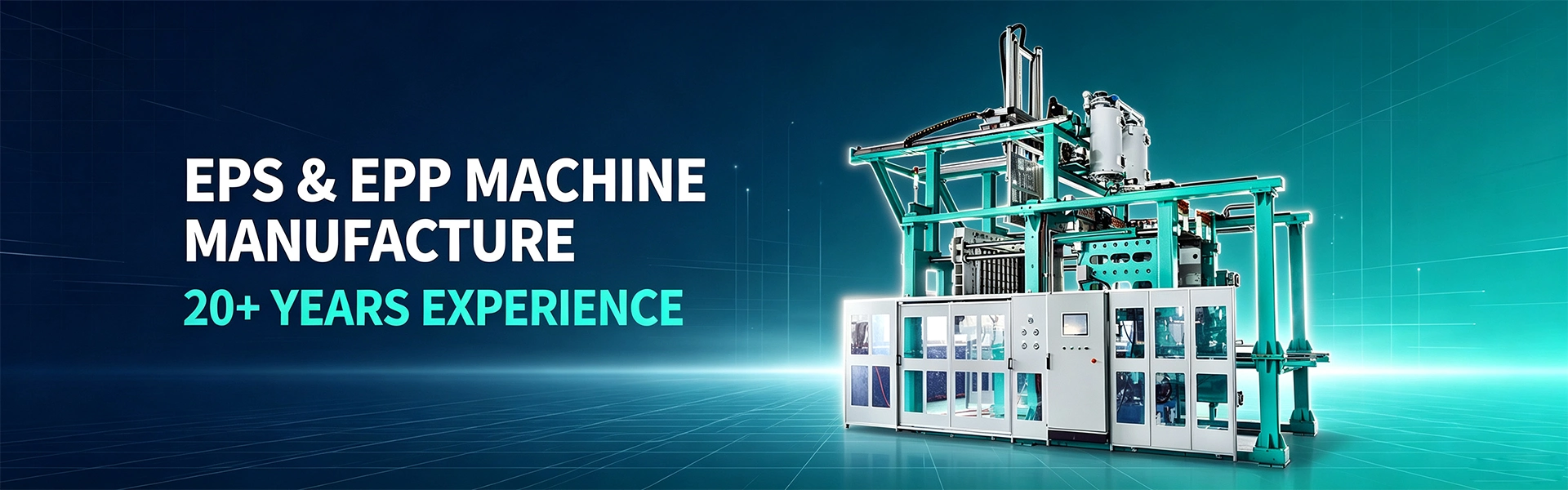
Selecting an EPS pre-expander is not simply a matter of choosing the largest machine or the lowest quotation. In an EPS production line, the pre-expander is one of the most important machines because it determines bead density, expansion stability, downstream molding consistency and final product quality. If the pre-expansion stage is unstable, even the best block molding machine or shape molding machine will struggle to produce consistent EPS products.
EPS manufacturing begins with expandable polystyrene resin beads. These beads contain a blowing agent that expands when exposed to controlled steam heat. The pre-expander turns high-density raw beads into low-density expanded beads before aging, molding and final product formation. This first expansion step defines the foundation for insulation boards, packaging inserts, fish boxes, helmet liners, architectural foam shapes, ICF blocks and many other EPS products.
For a new factory, the wrong pre-expander can create bottlenecks, density variation, energy waste and quality problems. For an existing factory, upgrading or adding a pre-expander may improve production capacity, reduce labor dependence and stabilize bead density. The right selection depends on your product type, target density range, daily output, steam capacity, automation needs and future expansion plan.
What Is an EPS Pre-expander?
An EPS pre-expander is a machine used to expand raw expandable polystyrene beads before molding. Raw EPS beads are small, dense and not ready for final product molding. During pre-expansion, steam heats the beads, activates the blowing agent and causes each bead to expand into a larger, lower-density particle. After expansion, the beads are usually transferred to aging silos, where internal pressure stabilizes before molding.
The pre-expander usually includes a feeding system, steam chamber, agitator, weighing or density control system, discharge system, drying or fluidized bed section and control panel. More advanced machines may include PLC control, touch screen operation, electronic weighing, automatic density correction, recipe storage and connection to central material handling systems.
The purpose of the pre-expander is not only to make beads larger. Its real purpose is to create expanded beads with stable density, uniform cell structure, proper surface condition and suitable moisture level for downstream molding. Poor pre-expansion can cause molding defects such as density variation, poor fusion, shrinkage, weak mechanical strength and inconsistent insulation performance.
For this reason, an EPS pre-expander should be selected as a process-control machine, not only as a capacity machine. The best machine is not always the biggest one. It is the machine that can repeatedly produce the bead density and quality your products require.
Why the Pre-expander Matters in EPS Production
In EPS production, many final product problems begin in the pre-expansion stage. If bead density is unstable, molded products will show inconsistent weight, strength and insulation performance. If beads are over-expanded, they may become fragile and difficult to mold. If beads are under-expanded, the final product may be too heavy or fail to meet density specifications.
The pre-expander also affects productivity. A machine with insufficient output can become the bottleneck of the entire production line. Even if molding machines have high capacity, they cannot operate efficiently if expanded beads are not available in the right quantity and density. On the other hand, an oversized machine may waste steam and investment if the factory does not need that capacity.
Energy consumption is another key factor. Pre-expansion uses steam, air and electricity. A machine with poor steam control may consume more energy while still producing unstable density. In competitive EPS manufacturing, energy cost can significantly affect long-term profitability.
The pre-expander also influences process flexibility. A factory producing only one standard density insulation board has different needs from a factory producing packaging parts, fish boxes, helmet liners and decorative shapes. Multiple products may require different densities, different bead sizes and different recipes. In this case, recipe management and density repeatability become especially important.
A well-selected EPS pre-expander improves not only bead quality, but also the stability of the entire production system. It reduces trial-and-error during molding, lowers reject rates and helps operators maintain predictable production conditions.
Batch Pre-expander vs Continuous Pre-expander
One of the first decisions is whether to choose a batch pre-expander or a continuous pre-expander. Both can expand EPS beads, but they are suited to different production patterns.
A batch pre-expander processes a measured quantity of raw beads in each cycle. The machine feeds a batch, expands it under controlled steam conditions, discharges the expanded beads and then begins the next batch. This method is suitable for factories that need accurate density control, frequent recipe changes or moderate production capacity.
Batch machines are often preferred when product variety is high. If your factory needs to produce different densities during the same day, a batch pre-expander can be easier to manage. Operators can adjust recipes, monitor each batch and maintain tighter control over density variation.
A continuous pre-expander feeds raw beads continuously and discharges expanded beads continuously. It is suitable for large-scale production where the same or similar density is produced for long periods. Continuous systems can provide high throughput and stable flow to large production lines when properly controlled.
The advantage of continuous pre-expansion is efficiency. It can support large-volume production with less start-stop operation. However, it may be less flexible when many density changes are required. It also requires stable raw material, stable steam supply and experienced process control.
For many buyers, the decision is not about which type is universally better. It is about which type matches the production model. If your factory produces multiple EPS products in medium batches, batch pre-expansion may be safer. If your factory produces large quantities of similar insulation boards or blocks, continuous pre-expansion may provide better efficiency.
Start with Your Target EPS Product Type
Before choosing machine capacity or automation level, you should define what EPS products you plan to produce. Different EPS products require different density ranges, bead sizes, aging times and molding conditions.
EPS insulation boards often require stable low to medium density and consistent thermal performance. For this application, uniform density and high output may be more important than frequent recipe changes. The pre-expander must deliver beads that can support block molding or board production with predictable density distribution.
EPS protective packaging may require different densities depending on product weight and fragility. A heavy appliance, a fragile electronic product and a lightweight consumer item do not need the same bead density. Packaging factories often benefit from a pre-expander that can handle multiple recipes with stable repeatability.
EPS fish boxes and cold-chain containers require density stability, surface fusion quality and insulation performance. Since these products may be produced in high volume, pre-expander throughput and stable steam supply are critical.
EPS architectural shapes and decorative foam products may require special density control because cutting, coating and handling performance depend on foam structure. If density is too low, the product may be too fragile. If density is too high, material cost increases and cutting efficiency may decrease.
A factory producing only one product family can select a more specialized system. A factory serving many customers should choose a pre-expander with stronger recipe flexibility, density control and data tracking.
Define the Required Density Range
Density is the most important technical parameter in EPS pre-expansion. The pre-expander must be able to produce the required density range consistently. EPS raw beads have a much higher initial bulk density, and the pre-expander reduces density by expanding the beads with steam. Lower final density means greater expansion, but it also requires careful control.
A buyer should define both normal operating density and extreme density requirements. For example, a factory may mostly produce 15 to 25 kg/m³ material, but occasionally need 10 kg/m³ or 30 kg/m³. The machine should be evaluated based on the full required operating window, not only one brochure density.
Low-density production is especially demanding. When beads are expanded to very low density, they become larger and more sensitive to over-heating, poor drying and handling damage. The pre-expander must control steam exposure and discharge carefully to avoid bead collapse or clumping.
High-density production has different requirements. The machine must prevent under-expansion and ensure bead uniformity. If the batch contains both under-expanded and over-expanded beads, the final molded product may have poor fusion and inconsistent mechanical performance.
Density control should also include repeatability. It is not enough to produce the target density once during testing. The machine must reproduce the same density across shifts, operators, raw material batches and environmental conditions.
Calculate Real Production Capacity
Pre-expander capacity should be calculated from real production needs, not only nominal machine output. Brochure capacity is usually measured under specific conditions. Actual output depends on target density, raw material grade, steam pressure, cycle time, drying performance and operator practice.
The first step is to estimate daily EPS consumption. How many cubic meters of molded product will you produce per day? What is the target density? How many production hours are available? From this information, you can estimate how many kilograms of expanded beads are needed per hour.
The second step is to consider product mix. If your factory produces both low-density insulation boards and higher-density packaging parts, capacity must be calculated separately for each density range. A machine that performs well at medium density may not deliver the same output at very low density.
The third step is to include operating losses. Cleaning, density changes, recipe adjustments, material transfer, maintenance and shift changes all reduce practical capacity. A factory should not select a machine that can only meet demand under perfect conditions.
A practical selection should include a capacity margin. However, excessive oversizing is also risky. If the machine is too large for the production volume, each batch may be too small for stable operation or the factory may pay for unused capacity. The correct capacity should cover current demand and reasonable future growth without creating unnecessary energy and investment waste.
Evaluate Steam System Compatibility
Steam is the heart of EPS pre-expansion. Without stable steam pressure, temperature and flow, density control becomes difficult. Before buying a pre-expander, the factory must check whether the boiler and steam pipeline can support the selected machine.
The pre-expander supplier should provide steam consumption data, required pressure range, valve specifications and pipeline recommendations. Buyers should compare these requirements with existing factory utilities. If steam supply is weak or unstable, even a high-quality pre-expander may fail to perform well.
Steam quality also matters. Wet steam, pressure fluctuation and poor condensate drainage can affect bead expansion. The system should include proper steam traps, pressure regulation and drainage design. In many factories, pre-expansion problems are not caused by the machine itself, but by unstable utility conditions.
If a factory plans to expand production in the future, steam capacity should be evaluated at the line level. A pre-expander, aging silos, block molding machines and shape molding machines may all require steam. Selecting a pre-expander without considering total steam demand can create downstream bottlenecks.
Energy efficiency should also be considered. A machine with better steam control can reduce waste, stabilize density and lower operating cost. Over many years of production, steam efficiency may have greater financial impact than the initial machine price difference.
Check Air, Power and Utility Requirements
In addition to steam, an EPS pre-expander may require compressed air, electrical power, cooling or drying airflow and material conveying systems. These requirements must be checked before purchase.
Compressed air is often used for valves, pneumatic components and material handling. Insufficient air pressure can cause unstable valve action or feeding problems. The supplier should specify pressure, flow and air quality requirements.
Electrical requirements should include motor power, control system voltage, heater or auxiliary load and local electrical standards. International buyers should confirm voltage, frequency and electrical cabinet compliance before production.
Material conveying is another factor. Expanded beads are light and bulky. The system must transfer them gently from the pre-expander to aging silos without excessive damage, static issues or blockage. Pipeline layout, blower size and silo arrangement should be planned together.
Factory layout matters as well. The pre-expander should be placed where raw material feeding, steam connection, discharge, maintenance access and silo connection are convenient. A machine that looks suitable on paper may become inefficient if installed in a poorly planned layout.
Consider Automation and Density Control Accuracy
Modern EPS pre-expanders can range from relatively simple manually adjusted machines to advanced automatic systems with PLC control, touch screen operation, electronic weighing and recipe storage. The right automation level depends on production complexity and operator skill.
For a small factory producing a limited product range, a basic automatic system may be sufficient. However, for a factory producing multiple densities, serving export customers or requiring tight quality control, advanced automation becomes more valuable.
Electronic weighing helps improve batch consistency. Instead of relying only on time or operator judgment, the machine can control raw bead input and expanded bead output more accurately. This supports better density repeatability.
Recipe storage is useful when product variety is high. Operators can store parameters for different densities, bead grades and product types. This reduces setup time and lowers the risk of human error.
Data tracking is becoming increasingly important. Factories that want better quality management may need production records, density history, alarm logs and batch traceability. This is especially useful for customers requiring consistent documentation or supplier audits.
Automation should not be seen only as a convenience feature. In EPS pre-expansion, automation can directly affect density stability, labor dependence, production repeatability and long-term quality control.
Match the Pre-expander with Aging Silos and Molding Machines
The pre-expander is only one part of the EPS production system. It must be matched with aging silos, material conveying, block molding machines, shape molding machines and cutting or finishing equipment.
After pre-expansion, EPS beads need aging time. During aging, internal pressure stabilizes, moisture redistributes and beads become more suitable for molding. If aging capacity is too small, the factory may be forced to use beads too early or stop pre-expansion even when molding demand continues.
Silo volume should be calculated according to pre-expander output, aging time, density, product mix and molding machine demand. Low-density beads occupy more volume than high-density beads, so silo planning must consider the lowest density products.
The pre-expander output should also match molding machine consumption. If the pre-expander produces too little, molding machines wait for material. If it produces too much without sufficient aging and storage capacity, bead handling becomes chaotic and density management suffers.
A complete EPS production plan should treat pre-expansion, aging and molding as one connected process. Buying a pre-expander without checking the rest of the line can lead to hidden bottlenecks.
Evaluate Energy Efficiency and Operating Cost
The purchase price of an EPS pre-expander is only one part of total cost. Over the life of the machine, steam consumption, electricity, maintenance, spare parts, labor and reject rates can have a much larger financial impact.
A cheaper machine may become expensive if it consumes more steam, produces unstable density or requires frequent maintenance. A more advanced machine may justify its cost if it reduces density variation, lowers waste and improves line productivity.
Energy efficiency should be evaluated through steam control design, insulation, valve response, process stability and drying efficiency. The more stable the process, the less correction and rework are needed downstream.
Labor cost should also be considered. A machine requiring constant manual adjustment may be acceptable in a small factory, but it can become a problem in a high-volume plant. Automation can reduce dependence on highly experienced operators.
Reject reduction is one of the most important hidden benefits. Stable pre-expansion improves molding quality, reduces scrap and improves customer consistency. Even a small reduction in reject rate can create significant savings over time.
Safety, Maintenance and Long-Term Reliability
EPS pre-expanders work with steam, pressure, moving parts and electrical control systems. Safety design must be taken seriously. The machine should include proper pressure protection, emergency stops, interlocks, temperature control and safe access for operators.
Maintenance accessibility is also important. Operators and technicians should be able to inspect valves, agitators, sensors, discharge systems, weighing devices and electrical components without excessive disassembly. A machine that is difficult to maintain may suffer from long downtime.
Spare parts availability should be checked before purchase. Valves, sensors, seals, motors and control components will eventually need replacement. A reliable supplier should provide spare parts lists, maintenance schedules and technical support.
Long-term reliability is influenced by material quality, welding quality, control system design and supplier experience. Buyers should not evaluate the machine only by appearance. They should ask about construction details, previous installations and service experience.
For overseas buyers, after-sales support is especially important. Installation guidance, commissioning support, remote troubleshooting and operator training can determine how quickly the machine reaches stable production after delivery.
How to Compare EPS Pre-expander Suppliers
When comparing suppliers, start with whether they understand your production requirements. A professional supplier should ask about your products, target density, daily capacity, steam system, factory layout, automation needs and future expansion plan before recommending a model.
Ask for technical specifications, not only photos. Useful information includes chamber volume, density range, output capacity under different densities, steam consumption, compressed air requirement, electrical load, control system configuration and discharge method.
Ask how density is controlled. Does the machine use weighing? Does it have recipe storage? Can it automatically correct process parameters? How does it handle density changes? These questions reveal whether the machine is designed for real process control.
Ask about integration. Can the supplier design aging silos, material conveying and line layout together with the pre-expander? A supplier that only sells one machine may not understand the full production system.
Ask about service. For international projects, installation and commissioning support are critical. The supplier should provide manuals, training, remote support and spare parts. If possible, ask for case references or similar installations.
A good supplier will not push the biggest machine by default. They will recommend the most suitable configuration based on your product mix, utilities, budget and growth plan.
Conclusion
Selecting an EPS pre-expander requires more than comparing machine prices. The pre-expander controls the first and most important transformation in EPS production: turning raw beads into stable expanded beads. Its performance affects density consistency, molding quality, energy consumption, production capacity and long-term profitability.
The right selection begins with your product type, required density range and real production volume. From there, you should evaluate batch versus continuous operation, steam system compatibility, automation level, aging silo capacity, line integration, energy efficiency and supplier support.
For a factory producing varied EPS products, flexibility and density repeatability may be more important than maximum output. For a factory producing large quantities of similar products, continuous high-capacity operation may be the key. For all factories, stable steam, correct silo planning and reliable process control are essential.
If you are planning to purchase an EPS pre-expander, the most effective next step is to prepare your production requirements clearly. Define your target products, density range, daily output, available steam capacity, factory layout and future expansion plan. With this information, an experienced EPS machine supplier can recommend a pre-expansion system that supports not only today's production, but also tomorrow's growth.