

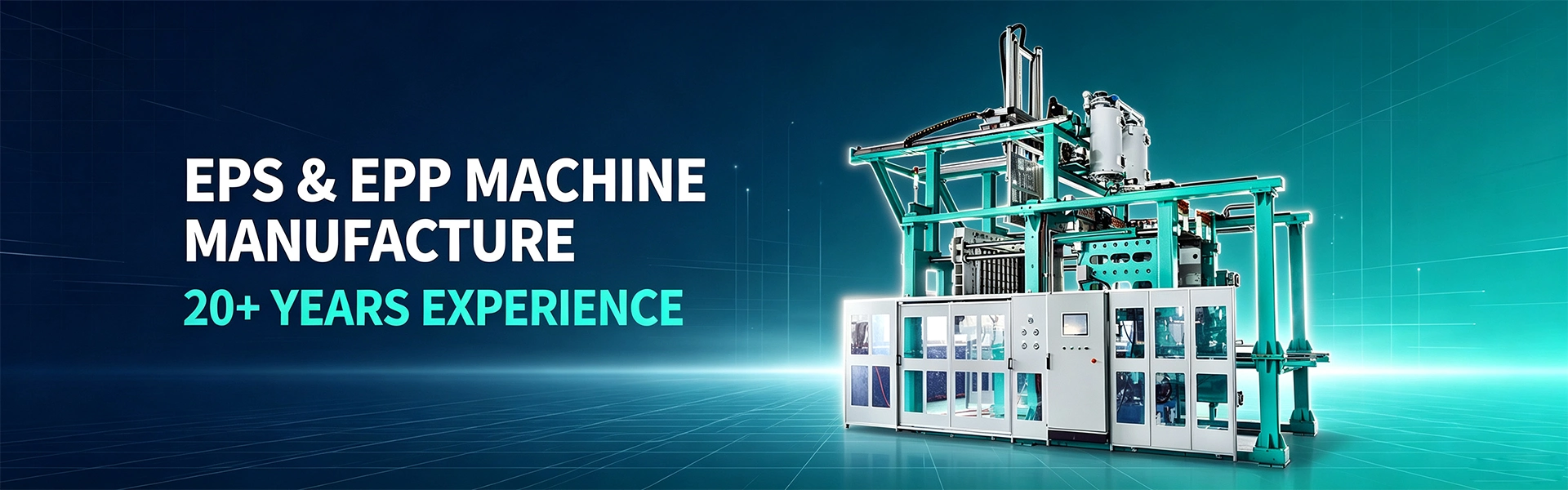
An EPS shape moulding machine is one of the most important machines for producing three-dimensional expanded polystyrene foam products. Unlike an EPS block molding machine, which creates large foam blocks for later cutting, a shape moulding machine produces finished or near-finished parts directly from molds. These parts can include protective packaging inserts, fish boxes, appliance packaging, helmet liners, corner protectors, cold-chain containers, decorative foam parts and many custom molded EPS products.
For buyers and manufacturers, selecting an EPS shape moulding machine is not simply about clamping size, machine price or automation level. The final production result depends on the match between machine structure, mold design, steam system, vacuum capacity, filling method, cooling efficiency, product geometry and factory utilities. A good machine with a poorly designed mold will not produce stable parts. A good mold installed on an underconfigured machine will also struggle to reach expected cycle time and quality.
Mold design is especially critical in EPS shape molding. The mold determines bead filling, steam penetration, venting, fusion, cooling, demolding, shrinkage control and surface quality. In many EPS factories, defects such as deformation, poor fusion, weak corners, uneven density, long cycle time or difficult demolding are not caused by the raw material alone. They often come from the combined effect of mold design and machine configuration.
What Is an EPS Shape Moulding Machine?
An EPS shape moulding machine is a machine that molds pre-expanded EPS beads into specific three-dimensional foam products using a dedicated mold. It is designed for products that need defined geometry, cavities, ribs, corners, walls, handles, lids, support zones or protective structures.
The machine typically includes a fixed platen, moving platen, hydraulic or mechanical clamping system, steam system, air system, vacuum system, cooling system, filling system, demolding system, control cabinet and safety devices. The mold is installed between the platens, and the machine cycles through filling, heating, fusion, cooling and demolding.
Compared with block molding, shape molding requires more precise mold design because each cavity directly creates the final product. If a packaging insert has weak corners, poor product fit or uneven wall density, the defect appears directly in the finished part. There is usually less opportunity to correct the problem after molding.
EPS shape moulding is widely used in packaging, cold-chain logistics, construction accessories, consumer product protection, agricultural boxes, furniture protection, electronics packaging and custom industrial cushioning. Its value lies in producing lightweight, protective and cost-effective foam parts with repeatable geometry.
How EPS Shape Moulding Works
EPS shape moulding begins with pre-expanded and aged EPS beads. The beads are transported from aging silos to the machine. During the filling stage, beads are blown into the mold cavity through filling guns. The goal is to distribute the beads evenly throughout the cavity without creating voids, overpacking or weak areas.
After filling, steam enters the mold. Steam heats the EPS beads, softens their surfaces and causes them to fuse together. In a well-designed mold, steam reaches all areas evenly so that the product has consistent fusion and strength. In a poorly designed mold, some areas may be over-heated while others remain weak.
After heating and fusion, the product must be cooled. Cooling reduces temperature, stabilizes shape and prepares the part for demolding. Vacuum may be used to remove steam and moisture, accelerate cooling and improve cycle time. Some machines also use water cooling or air cooling depending on configuration.
Finally, the mold opens and the part is ejected or removed. The demolding stage must be controlled carefully because EPS products can deform if they are still hot, under-cooled or mechanically stressed. Complex parts may require ejector pins, air ejection, stripper plates or special release design.
The full cycle may look simple, but every stage depends on the connection between mold and machine. Filling, steam, vacuum, cooling and demolding must be designed as one system.
Start with Product Geometry and Application
Before selecting a machine or designing a mold, manufacturers must understand the target product. Product geometry determines mold complexity, filling method, cooling demand, demolding strategy and machine size.
A simple protective corner has very different requirements from a deep fish box, a large appliance packaging insert or a multi-cavity electronics tray. Deep cavities may require careful filling gun placement. Thin walls may require precise steam control. Large flat surfaces may need shrinkage management. Complex undercuts may require special demolding design.
Application also matters. A fish box must provide insulation, water resistance and stacking strength. An electronics packaging insert must provide accurate fit and controlled cushioning. A helmet liner must meet impact absorption and dimensional requirements. A decorative EPS part may prioritize surface quality and cutting or coating compatibility.
The mold designer should review product drawings, wall thickness, cavity depth, load-bearing zones, visible surfaces, stacking requirements, tolerance requirements and expected production volume. Without this information, mold design becomes guesswork.
A professional EPS equipment supplier should not recommend a machine before understanding the product. Machine selection must follow product requirements, not the other way around.
Key Machine Configuration Factors
The first machine selection factor is platen size. The platen must fit the mold size, including cavity, steam chamber, mounting structure and connection space. Buyers should not choose platen size based only on product dimensions. The complete mold envelope must be considered.
The second factor is clamping force and opening stroke. The machine must close the mold securely during steam heating and allow enough opening space for demolding. Deep products may require larger opening stroke. Heavy molds require stable platen movement and strong mechanical structure.
The third factor is steam configuration. The machine should provide stable steam pressure, fast response and proper distribution to the mold. Different products may require different heating methods, such as cross steam, direct steam, back steam or combined steam control.
The fourth factor is vacuum capacity. Vacuum helps air removal, steam penetration and cooling. For deep or complex EPS products, insufficient vacuum can lead to poor fusion, long cycles and deformation.
The fifth factor is automation level. PLC control, touch screen operation, recipe storage, automatic filling and process monitoring can improve repeatability. For high-volume production or multi-product factories, automation can reduce operator dependence.
Mold Design Principles for EPS Products
EPS mold design must balance filling, steam, venting, cooling and demolding. A mold that only reproduces the product shape is not enough. It must also create the correct process conditions.
The first principle is uniform bead filling. The mold must allow beads to reach all areas of the cavity. Long flow paths, narrow passages, deep corners and isolated cavities can create filling problems. Filling gun placement should be designed according to product geometry.
The second principle is balanced steam penetration. Steam must heat the beads evenly. Thick areas, thin areas and hidden corners may require different venting or steam support. Poor steam balance can create weak zones or over-expanded regions.
The third principle is controlled venting. Air must escape as beads fill and steam enters. Vents also help distribute steam and remove moisture. Vent size, quantity and position influence both product quality and cycle time.
The fourth principle is shrinkage and deformation control. EPS products can shrink or deform if wall thickness, cooling or demolding is not balanced. Mold design should consider expected shrinkage, support surfaces and cooling paths.
The fifth principle is maintainability. Vents, filling guns, seals and ejector components must be accessible for cleaning and replacement. A mold that is difficult to maintain may produce good samples but unstable mass production.
Mold Material and Structure Selection
EPS molds are commonly made from aluminum because aluminum has good thermal conductivity, is relatively easy to machine and is lighter than steel. Good thermal conductivity helps heating and cooling efficiency, which affects cycle time and product stability.
For high-volume production, mold material quality and surface treatment become important. The mold must withstand repeated steam heating, cooling, pressure, moisture and mechanical movement. Poor material selection may lead to corrosion, deformation or surface wear.
Mold structure usually includes cavity plates, steam chambers, back plates, filling gun ports, vents, seals, water or cooling channels if needed, ejector systems and mounting interfaces. Each structure must match the machine interface.
For multi-cavity molds, balance is critical. All cavities should fill, heat and cool at similar rates. If one cavity fills faster or cools slower, product quality and cycle time become inconsistent.
The mold should also be designed for installation and changeover. Factories producing many product types may need faster mold change systems, clear connection layouts and standardized mounting dimensions.
Filling Gun Layout and Bead Distribution
Filling gun layout is one of the most important mold design details. EPS beads are light and flow differently from liquid or molten plastic. They must be blown into the cavity and distributed through air movement.
If filling guns are placed poorly, some areas may be underfilled while others are overpacked. Underfilled areas cause voids and weak fusion. Overpacked areas can create density variation and deformation. Deep products often require multiple filling points or carefully directed filling paths.
The number of filling guns depends on product size, cavity depth, bead density and machine air system. More filling guns are not always better. Poorly balanced multiple filling points can create turbulence or uneven packing.
Filling gun maintenance is also important. Blocked or worn filling guns can create sudden production defects. Mold design should allow operators to inspect and clean filling guns without excessive downtime.
For products requiring consistent weight and fit, filling accuracy should be validated during sampling. The supplier should check product weight variation, cavity completeness and weak zones before mass production.
Steam Chamber, Venting and Fusion Quality
Steam chamber design determines how heat reaches the EPS beads. The steam chamber must distribute steam evenly across the mold surface and through the cavity. If steam cannot reach certain areas, the beads will not fuse properly.
Vents are small but critical components. They allow air to escape and steam to penetrate. Vent placement should follow product geometry. Corners, deep ribs, isolated cavities and thick sections often need special venting attention.
Too few vents can cause trapped air, poor fusion and visible defects. Too many or poorly positioned vents can mark the product surface or reduce local strength. The goal is controlled and balanced venting.
Fusion quality affects product strength, cutting behavior, dimensional stability and user confidence. A fish box with weak fusion may crack under stacking. A packaging insert with weak fusion may crumble during transport. A protective EPS part with poor fusion may fail when absorbing impact.
Good fusion requires matching mold venting, steam pressure, heating time, bead condition and machine control. It cannot be solved by increasing steam randomly. Excessive steam may cause shrinkage, deformation or longer cooling time.
Vacuum, Cooling and Cycle Time Control
Cooling is one of the biggest factors in EPS shape moulding productivity. After steam fusion, the product must cool enough to hold its shape before demolding. If demolded too early, it may shrink, warp or deform.
Vacuum helps remove steam and moisture from the mold and product. It can reduce cooling time and improve product stability. For deep products or thick sections, vacuum can be especially valuable because heat removal is more difficult.
The machine vacuum system should match mold size and product volume. A weak vacuum system may create long cooling cycles and unstable demolding. A well-sized vacuum system can improve output without sacrificing quality.
Cooling water temperature and flow may also affect cycle time. In some machine designs, cooling water is used to support mold temperature control or vacuum condensation. If water is too warm or flow is insufficient, cooling efficiency drops.
Cycle time should be evaluated based on the actual product, not only machine specifications. Thin packaging parts, deep boxes and thick protective inserts will not have the same cycle. The supplier should estimate cycle time according to product geometry, density and mold design.
Demolding System and Product Stability
Demolding is often underestimated in EPS shape molding. Because EPS products are lightweight and relatively soft after heating, they can be damaged if ejected incorrectly. Deformation, corner damage, surface marks and cracking may occur during demolding.
The demolding system may use ejector pins, air blowing, stripper plates, mechanical pushers or manual assistance. The correct method depends on product geometry and surface requirements. Visible surfaces should avoid heavy ejector marks when possible.
Draft angles are important. A product with vertical walls and no draft may stick in the mold. Small draft angles can improve release and reduce demolding force. However, draft must be balanced with product fit requirements.
Cooling also affects demolding. A product that is still too hot may deform during ejection. A product that is overcooled may increase cycle time unnecessarily. The process must find the right demolding window.
During sampling, demolding should be tested repeatedly. A mold that releases well once may still create problems during continuous production if moisture, temperature or cycle conditions change.
Automation, PLC Control and Recipe Management
Automation is increasingly important in EPS shape moulding. Modern machines can use PLC control, touch screen operation, automatic filling, steam timing, vacuum control, cooling settings, recipe storage and alarm monitoring.
Recipe management is valuable when a factory produces multiple products. Different molds require different filling time, steam pressure, heating time, vacuum time and cooling settings. Storing recipes reduces setup time and operator error.
Automatic process control improves repeatability. Manual adjustment may depend heavily on operator experience. Automation helps maintain consistent parameters across shifts and operators.
Alarm systems and data recording support quality management. If a cycle fails because of low steam pressure, weak vacuum or abnormal cooling time, the system should help operators identify the problem quickly.
Automation should be matched to factory needs. A small workshop may not need the highest automation level, but a factory serving export packaging customers or high-volume production should prioritize stable process control.
Equipment Selection Based on Production Requirements
To select the right EPS shape moulding machine, buyers should first define product size, mold size, cavity number, target density, cycle time, daily output and available utilities. These factors determine the required machine configuration.
For small products with many cavities, the machine must support accurate filling and balanced mold heating. For large products such as fish boxes or appliance packaging, platen size, opening stroke, vacuum capacity and demolding stability become more important.
For high-output production, cycle time and mold change efficiency matter. Faster steam response, strong vacuum, reliable cooling and stable automation can improve productivity. For low-volume custom production, flexibility and mold compatibility may be more important.
Utility conditions must be checked. The machine requires steam, compressed air, cooling water, electricity and sometimes central material conveying. If factory utilities are weak, the selected machine may not reach its designed performance.
Buyers should also consider future products. If the factory may add larger molds or more complex products later, the machine should have enough flexibility and reserve capacity. However, excessive oversizing increases investment and energy cost.
Common Mold and Machine Matching Mistakes
One common mistake is selecting the machine before analyzing the mold. If the platen is too small, opening stroke is insufficient or filling system does not match the cavity, production problems appear immediately.
Another mistake is focusing only on mold shape while ignoring steam and venting. A mold may look correct in CAD, but if steam cannot reach all areas evenly, the product will have weak fusion or deformation.
A third mistake is underestimating cooling. Buyers may expect fast cycles, but the mold and machine may not remove heat quickly enough. This leads to long cycle times or unstable demolding.
A fourth mistake is using one machine for too many mismatched molds. While flexibility is useful, not every mold is suitable for every machine. Heavy molds, deep products or large cavities may require specific machine specifications.
A fifth mistake is ignoring operator training. Even a well-designed mold and machine require operators who understand filling, steam, vacuum, cooling and demolding. Without training, production stability depends too much on trial and error.
How to Evaluate EPS Shape Moulding Machine Suppliers
A qualified supplier should evaluate both machine and mold requirements. They should ask for product drawings, target density, expected output, mold size, cavity number, utility conditions and quality requirements before recommending a machine.
The supplier should provide technical specifications, including platen size, opening stroke, clamping system, steam valve configuration, vacuum capacity, cooling method, filling system, control system and safety features.
Mold design capability is a major advantage. A supplier that understands both EPS machine design and mold design can reduce communication gaps. They can design filling guns, vents, steam chambers and demolding systems according to machine capability.
Sampling support is also important. Before mass production, the supplier should support mold trial, parameter adjustment and defect analysis. This helps identify filling problems, fusion issues, cooling imbalance or demolding difficulties early.
For international buyers, after-sales service matters. Installation guidance, commissioning support, spare parts, remote troubleshooting and operator training can determine how quickly the machine reaches stable production.
The best supplier does not simply sell a standard machine. They help match machine, mold and production process into a stable manufacturing system.
Conclusion
An EPS shape moulding machine is only as effective as the mold and process system around it. Stable production depends on the correct match between product geometry, mold design, machine configuration, steam control, vacuum capacity, cooling performance, demolding method and operator training.
Mold design should begin with the product application. A fish box, packaging insert, protective corner or custom foam part each requires different filling, venting, cooling and demolding strategies. Equipment selection should then follow the mold and production requirements.
When evaluating an EPS shape moulding machine, buyers should look beyond price and platen size. They should examine steam distribution, vacuum system, filling control, automation, mold compatibility, utility requirements and supplier engineering support.
If you are planning to produce EPS molded products, the most effective next step is to prepare product drawings, target density, expected output, mold requirements and factory utility information. With these details, an experienced EPS machine and mold supplier can recommend a configuration that supports reliable production, shorter cycles and better long-term return on investment.